
01
List
Identify every component in the power circuits, from the main disconnect to the motor starters.

SCCR, the short-circuit current rating, is the highest fault current a control panel can safely withstand, shown in kA on its nameplate. It must be at least as high as the fault current available where the panel is connected. Under UL 508A, a panel's SCCR is set by the lowest-rated component in its power circuit, unless a current-limiting device protects that component.
When a short circuit happens, the current that flows is limited only by the supply: the transformer size, cable lengths and the utility network. That available fault current can be many times the normal load current.
If the panel's SCCR is lower than the fault current available at its terminals, components can fail violently during a fault. That is why the SCCR is marked on the panel, and why inspectors compare it with the site's available fault current before the panel is energized.

Every component in the power circuit has its own short-circuit rating. The panel can only be as strong as the lowest one, unless that component is protected by a current-limiting device.
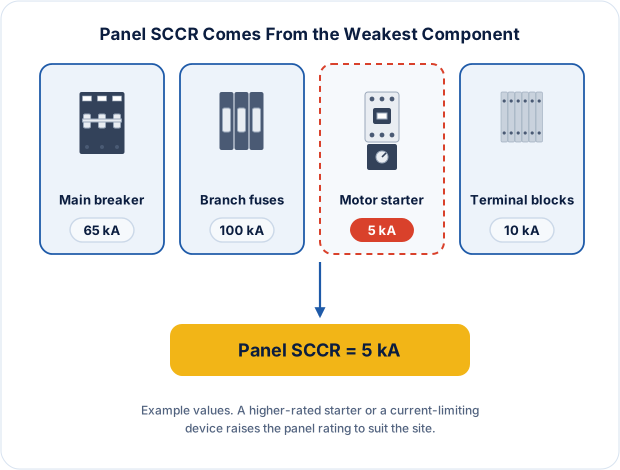
UL 508A gives a step-by-step method, applied to the actual parts list of the panel.
Identify every component in the power circuits, from the main disconnect to the motor starters.
Record each component's short-circuit rating, or the standard default value where none is marked.
Account for current-limiting fuses or breakers that protect downstream components.
The lowest resulting value becomes the panel SCCR on the nameplate.
When the calculated SCCR is lower than the site needs, these are the usual ways to raise it. Each has a cost, so the right fix depends on where the weak point is.
| Option | How it helps |
|---|---|
| Higher-rated components | Swap the weakest part for one with a higher short-circuit rating. |
| Current-limiting fuses | Class J or Class CC fuses limit the fault energy that reaches downstream parts. |
| Current-limiting breakers | Breakers tested in combination with the downstream parts can raise the branch rating. |
| Tested combinations | Use manufacturer-tested starter and drive combinations with published high ratings. |
| Isolating transformer | A control transformer limits fault current on the circuits it feeds. |
We work out the SCCR at the design stage, so the panel reaches the rating your site needs without changes at the end.
Give the panel shop the available fault current at the point where the panel will be connected. Your electrical engineer, a short-circuit study or the utility can usually provide it.
If the figure is not known yet, agree a target such as 65 kA early. Changing the SCCR after components are bought costs time and money, while designing to the right value from the start costs very little.

It varies widely. Panels with default-rated parts may be around 5 kA, while panels designed with current-limiting protection commonly reach 65 kA or more. The right value is whatever your site's available fault current needs.
From your electrical engineer's short-circuit study, the utility, or the engineer of record for the building's electrical system.
No. The interrupting rating is about the breaker opening a fault safely. SCCR is about the whole panel withstanding a fault, and it is limited by the weakest component.
Sometimes, by changing components or adding current-limiting fuses, but it is far cheaper to design for the right value from the start.
What the UL 508A label covers, how SCCR is set, and what we check before a panel is labeled.
What the standard covers, what the label means and what it does not.
Full-voltage and soft starters, overloads and SCCR for every motor branch.
Send what you have: drawings, an I/O list or a short description of the process. We will reply with questions, a quotation and a schedule.