
PLC Control Panels
Controllers, I/O, networks and power, built to UL 508A and tested point by point.

Relay logic still suits very small, fixed systems such as a simple pump or fan with a few interlocks. Once a system has more than a handful of inputs, timers or sequences, a PLC is usually cheaper to build, much easier to change, and far easier to troubleshoot, because the logic lives in a program instead of in the wiring.
In a relay panel the logic is the wiring. In a PLC panel the wiring just connects inputs and outputs, and the logic is the program.
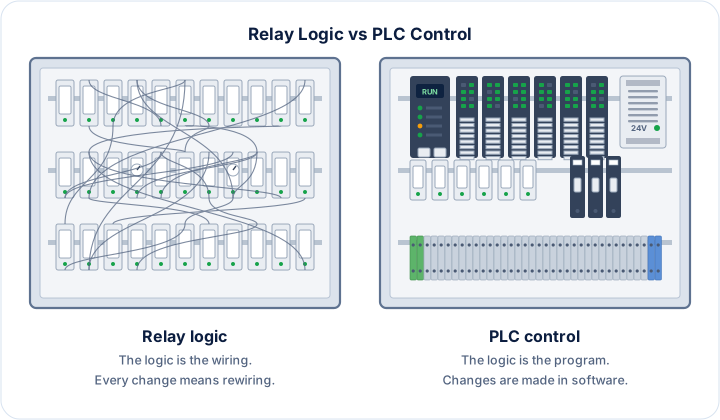
For a few functions, relays win on simplicity. As the logic grows, the PLC pulls ahead on every other point.
| Relay logic | PLC | |
|---|---|---|
| Best for | A few fixed functions | Sequences, timers, analog control |
| Making changes | Rewire and update drawings | Edit and download the program |
| Troubleshooting | Meter and drawings | Live status on laptop or HMI |
| Panel space | Grows with every function | Mostly fixed by I/O count |
| Remote monitoring | Difficult | Built in over Ethernet |
| Spare parts | Common relays and timers | Controller and I/O modules |

A single motor starter with a start, stop and overload needs no PLC. Neither does a simple float-switch pump panel where the logic will never change and the owner has no one to support a program.
Hard-wired circuits also remain alongside PLCs for some safety functions, where a safety relay or a hard-wired emergency stop removes power regardless of what the program is doing.
Many plants still run relay panels built decades ago. When they become hard to maintain, we replace the relay logic with a PLC, keeping the sequence operators know and adding an HMI and alarms they did not have before.
The field wiring can often stay, landing on new terminals in the same positions, which keeps the changeover short.

Not once the logic grows. A small PLC can replace dozens of relays and timers, saving panel space and wiring labor.
Usually a compact controller such as Allen-Bradley Micro800, Siemens S7-1200 or Schneider Electric Modicon, matched to your plant standard.
Often a few. Interposing relays protect PLC outputs and switch higher loads, and safety relays handle emergency stops.
Yes. We engineer, build and program the replacement, and test it at FAT before it goes to site.
Controllers, I/O, networks and power, built to UL 508A and tested point by point.
Programs written in-house for Allen-Bradley, Siemens and Schneider Electric, tested at FAT.
Plain-English definitions of the terms used in panel specs and quotes.
Send what you have: drawings, an I/O list or a short description of the process. We will reply with questions, a quotation and a schedule.