
Design & Engineering
Control narratives, HAZOP and SIL identification, process flow diagrams and panel drawings.

A control narrative is a plain-language description of how a control system should operate. It covers the process, the equipment and instruments, the operating modes, the normal start and stop sequences, interlocks, alarms, what operators see and change on the HMI, and what happens on power or signal loss. It becomes the reference for the drawings, the PLC program and the test procedures.
Most narratives follow the same eight sections. Interlocks and fail-safe states are the two most often missed.
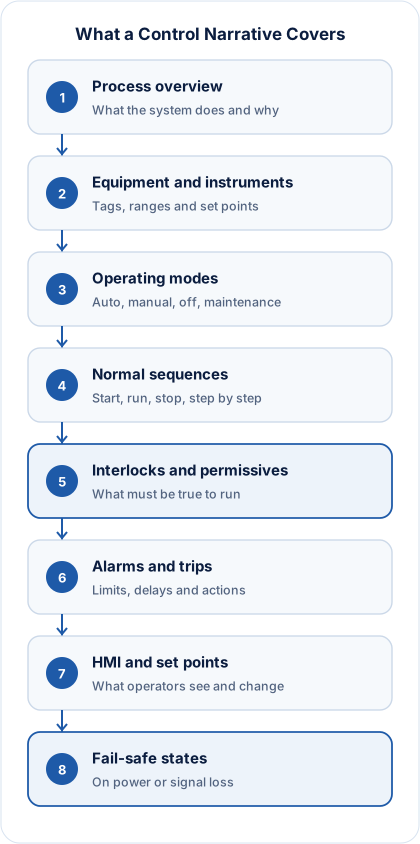

The narrative is the agreement between the people who know the process and the people who build the controls. When it is clear, the programmer writes what the plant needs, and the FAT tests against what was agreed, not against memory.
When it is missing, those decisions are made at the keyboard or on site during startup, which is the most expensive place to make them.
Good narratives use numbers, tags and conditions instead of general phrases. A few examples from a duplex pump station:
| Weak | Clear |
|---|---|
| Start the pump when the level is high | Start lead pump P-101 when LIT-100 rises above 6.0 ft |
| Stop the pumps when the tank is empty | Stop all pumps when LIT-100 falls below 1.5 ft |
| Alternate the pumps | Swap lead and lag after each pump-down cycle |
| Alarm on high level | Alarm when LIT-100 is above 8.0 ft for 10 s, or LSHH-100 trips |
| Protect the pump | Stop the pump and alarm if no run feedback within 5 s of start |
Tags and values are examples only.
Whoever knows the process best, working with the controls engineer. At WETS AI our engineering team can write it with you as part of the project.
Long enough to describe every sequence, interlock and alarm clearly. A small pump panel may need a few pages; a full treatment plant can need many.
They are close. A functional specification is often more formal and may include the narrative alongside I/O lists, screen layouts and test plans.
Yes. Our engineers prepare control narratives, HAZOP and SIL input, process flow diagrams and panel drawings, led by a Texas-licensed Professional Engineer.
Control narratives, HAZOP and SIL identification, process flow diagrams and panel drawings.
Programs written in-house for Allen-Bradley, Siemens and Schneider Electric, tested at FAT.
What to check, and what to ask for, at a factory acceptance test.
Send what you have: drawings, an I/O list or a short description of the process. We will reply with questions, a quotation and a schedule.