Testing, FAT & SAT
The 13 checks every panel passes, plus witnessed FAT and SAT on site.

A factory acceptance test (FAT) happens in the panel shop before shipping and proves the panel and program match the design, using simulated signals. A site acceptance test (SAT) happens after installation and proves the whole system works with the real field devices and process. FAT finds build and program problems early; SAT finds what only shows up on site.
FAT and SAT sit at either end of shipping and installation. Each one checks a different kind of risk.
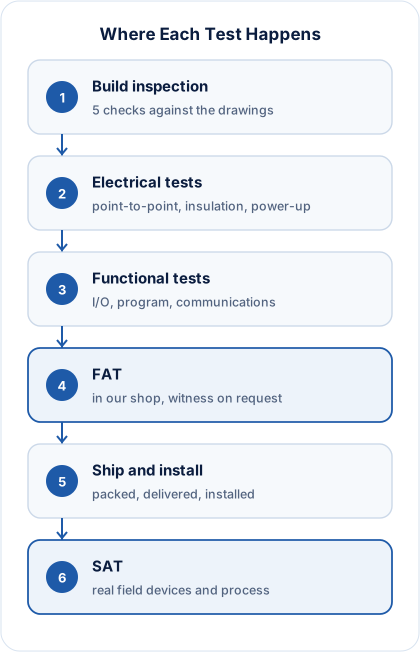
Both tests use a written procedure. The difference is what is connected to the panel when it runs.
| FAT | SAT | |
|---|---|---|
| Where | Panel shop | Your site, after installation |
| When | Before shipping | After installation and field wiring |
| Signals | Simulated I/O | Real instruments and equipment |
| What it proves | Panel and program match the design | The system works with the process |
| Typical problems found | Wiring errors, program logic, screen issues | Field wiring, instrument ranges, process tuning |
| Cost to fix | Low: tools and parts are at hand | Higher: travel, downtime and access |
Most SAT delays come from things that are not ready on site. Check these before the test date.

Every problem fixed at FAT is one less problem during startup, when the plant is waiting and every hour costs money. In the shop, the drawings, parts and tools are on hand, and nothing is running.
SAT is still needed, because some things can only be proven on site: the field wiring, the real instruments, and how the process actually behaves. With a good FAT behind it, SAT can focus on those.
They overlap. Commissioning is the wider process of bringing the system into service. SAT is the formal test, with a written procedure, that proves it works and is accepted.
Parts of it can, by video, but a witnessed FAT in person lets you see and operate the panel yourself. At WETS AI, witnessed FAT is available on request.
Usually the system integrator or panel shop, based on the control narrative, with the customer reviewing and approving them.
Yes. We verify the system on site with your team, using the real field devices and process.
The 13 checks every panel passes, plus witnessed FAT and SAT on site.
What to check, and what to ask for, at a factory acceptance test.
The sections every narrative needs, with examples.
Send what you have: drawings, an I/O list or a short description of the process. We will reply with questions, a quotation and a schedule.